Virality
Overview
Virality is built into Jest by design. Because the platform lives inside messaging - a surface that is inherently social - users can share and invite others as part of their natural behavior.
Jest turns these existing interactions into a distribution channel. From within an app, users can share invite links directly in their conversations or via social media, making every player a potential source of new users.
When a recipient taps an invite link, the app opens instantly in their browser - no app store, download, or upfront account creation required. This low-friction entry dramatically improves conversion.
Because these links support full attribution, Jest can identify who referred each user. This enables seamless onboarding and immediate reward distribution for both the sender and the recipient.
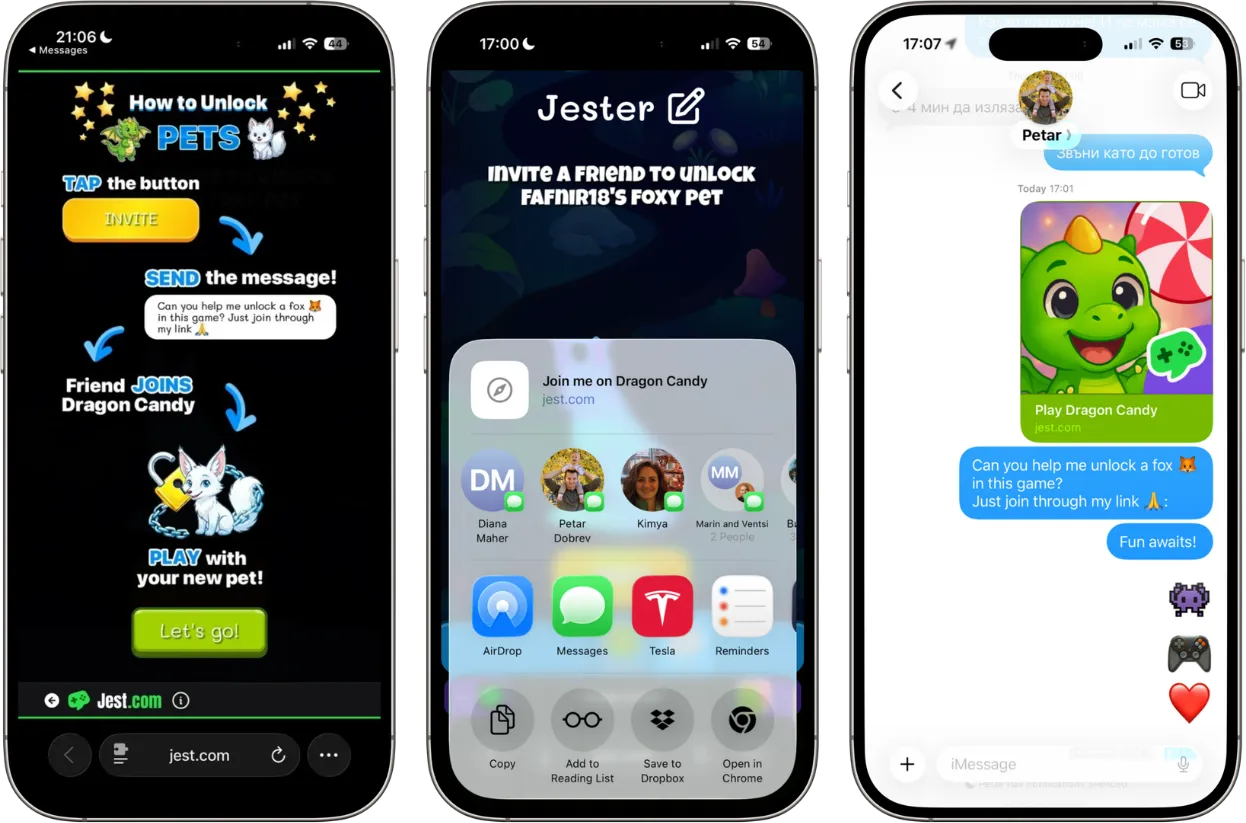
Example of a rich referral invite sent via messaging
The Jest virality framework
To build an effective growth engine on Jest, it’s critical to focus on the form of virality that actually drives new user acquisition. While several types of virality exist, only one directly expands your user base.
| Type | What it is | Impact on growth | Role in your strategy |
|---|---|---|---|
| Outside-network virality | Users invite people who are not yet on Jest | High - directly drives new user acquisition | Primary focus |
| Within-network virality | Interactions between existing Jest users (e.g. chat, sharing screenshots) | Indirect - improves engagement and retention | Supporting |
| Soft virality | Passive sharing (e.g. generic “Share” buttons) | Low - rarely drives meaningful acquisition | Low priority |
Outside-network virality is the core driver of growth. Because Jest apps open instantly via link with minimal friction, it turns everyday messaging into a powerful acquisition channel.
A typical viral loop on Jest looks like this:
- A user invites someone
- The recipient joins instantly
- Both receive value (e.g. rewards, progress, interaction)
- The new user repeats the process
Design your core loop around this behavior, and use the other forms of virality to support engagement once users are already in the app.
Designing viral mechanics
Since outside-network virality is the primary driver of growth, it must be intentionally designed into your core app or game loop. The most effective implementations feel less like features and more like fundamental parts of the experience.
Design mindset
A useful heuristic: if removing the sharing mechanic does not meaningfully weaken your app or game loop, it’s not strong enough.
Inviting others should feel like the natural next step in app engagement - not an optional action buried in the UI. The goal is to make sharing intrinsic, not additive.
Core principles
-
Make sharing meaningfully rewarding
Users invite others when the payoff is compelling. Rewards should have real impact within your app - unlocking content, accelerating progression, or enabling access to features. Sharing should feel like a high-leverage action, not a minor bonus. -
Design for repeatability
One-off invites limit growth. Strong viral loops give users a reason to invite repeatedly over time - through recurring rewards, evolving challenges, or systems that continuously benefit from new users. Your most engaged users should drive ongoing acquisition, not just a single spike. -
Build for async, not sync
Synchronous multiplayer is difficult to coordinate in messaging contexts. Asynchronous mechanics - such as turn-based play, challenges, or shared progress - fit naturally into how people communicate. They allow invites to convert without requiring both users to be active at the same time. -
Use cooperation or competition intentionally
Both can drive sharing, but they behave differently: Cooperation (teams, shared goals, pooled resources) tends to have broader appeal and encourages users to invite others to help them succeed. Competition (PvP, leaderboards) can be highly engaging but often appeals to a narrower audience.
Choose the dynamic that fits your core loop, and ensure it naturally creates reasons to invite others.
Technical implementation and attribution
Once you’ve designed your viral loop, Jest provides the tools to implement it and track its performance.
The Referrals API
The referrals SDK module enables you to trigger native share flows with custom messaging and rich preview cards. These flows are designed to maximize conversion while keeping sharing friction low.
Referral attribution with entryPayload
When a user joins via a referral link, the entryPayload is preserved and can be accessed after login using JestSDK.getEntryPayload().
This allows you to:
- attribute each new user to the exact referrer
- reward both users immediately upon entry
- track which features or mechanics are driving acquisition
By passing structured data through entryPayload, you can trigger contextual app logic based on how the user arrived - keeping your acquisition systems explicit, debuggable, and flexible.
Invited users can also be routed through dedicated onboardings, allowing you to tailor the first-time experience and further improve conversion.